Little Kitten Maiden Grass vs Giant Miscanthus: Size and Use
"I typed 'miscanthus' into a search box and got a photo of a plant towering over a barn. Is that the one I'm buying?" One of the most common questions we get arrives in almost those exact words, and the answer is no, not if you are buying Little Kitten. The two share a genus name and almost nothing else.
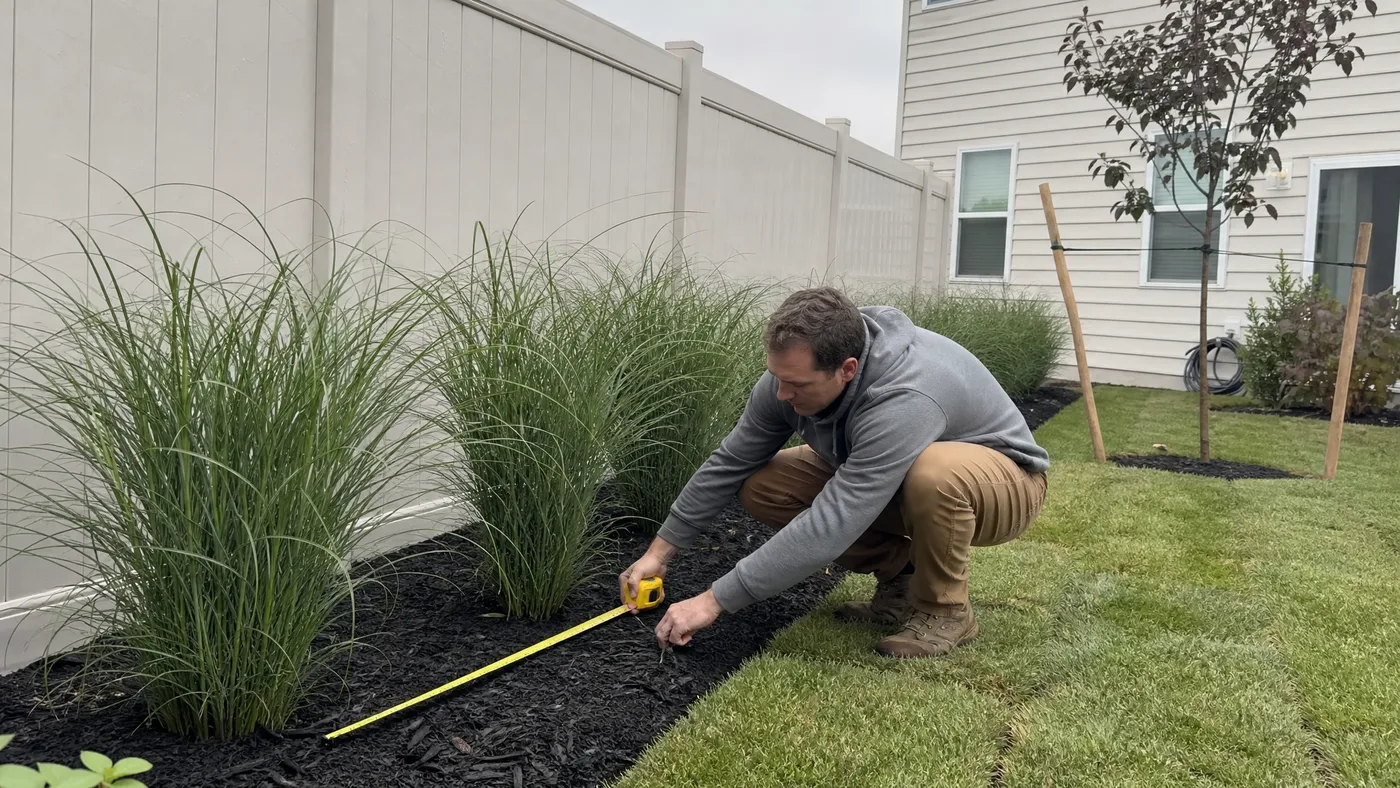
Before you buy either, it helps to ask what number you actually need to plan for. Size decides how many plants you order, what they hide and what you trim. Get it wrong and you end up with a 12-foot wall where you wanted an edge, or a knee-high row where you wanted privacy. We will use one fixed measurement all the way through: a forty-foot back fence.
Read on for the terms that matter, the plant counts and heights for each grass along that fence, a cost comparison, and a revised plan that puts each plant where its size belongs.
Defining Terms Before Measuring the Fence Line
Four words do most of the work in this comparison, so we define them first. Each one will come back when we start counting plants.
- Cultivar: a plant selected and named for consistent traits, written in single quotes after the botanical name. Little Kitten is the cultivar Miscanthus sinensis 'Little Kitten', so you get its compact habit every time rather than a gamble.
- Hybrid: a cross between two different parent plants, flagged by an "x" in the name. Miscanthus x giganteus is a hybrid, and it is sterile, which matters later.
- Height at maturity: the size a plant reaches once it is settled in, measured with its flower stems. For Little Kitten that is 3–4 feet. For giant miscanthus it is up to 12 feet.
- Spacing: the distance from the center of one plant to the center of the next. You set it by mature width, not by the size of the pot. Little Kitten is about 3 feet wide, so it goes in about 3 feet apart.
Think of spacing like chairs at a table. You do not seat people by how big the chair looked in the store. You seat them by how much room the person needs once they sit down. A plant's mature width is the person, and the pot is only the chair it arrived in.
Now the example. Picture a back fence 40 feet long and 6 feet tall, facing the sun for most of the day. That fence height is our assumption, so swap in your own. Every number in the next sections applies to that one stretch of ground, and two figures per plant, height and width, are all the math you need.
What Little Kitten Maiden Grass Would Do Along That Fence
Next we walk through how this grass would fill a long, sunny fence line. First we work out how many plants the row takes and how they sit together. Then we compare the plant's height to the boards behind it, and finally we cover where to site it and how little care it needs.
Counting the Plants
Divide 40 feet by a 3-foot spacing and you get 13.3, which we round down to 13 plants. Set them 3 feet apart, center to center. Twelve gaps plus half a clump at each end covers about 39 feet, which is close enough that no one will see the missing foot.
Because each clump is about 3 feet wide, neighbors just touch at maturity. You get one continuous low band rather than 13 separate mounds, and that is the look most people picture when they say "grass border." Give the first and last plant a little room from the fence ends so the band does not look cut off.
Reading the Height Against the Boards
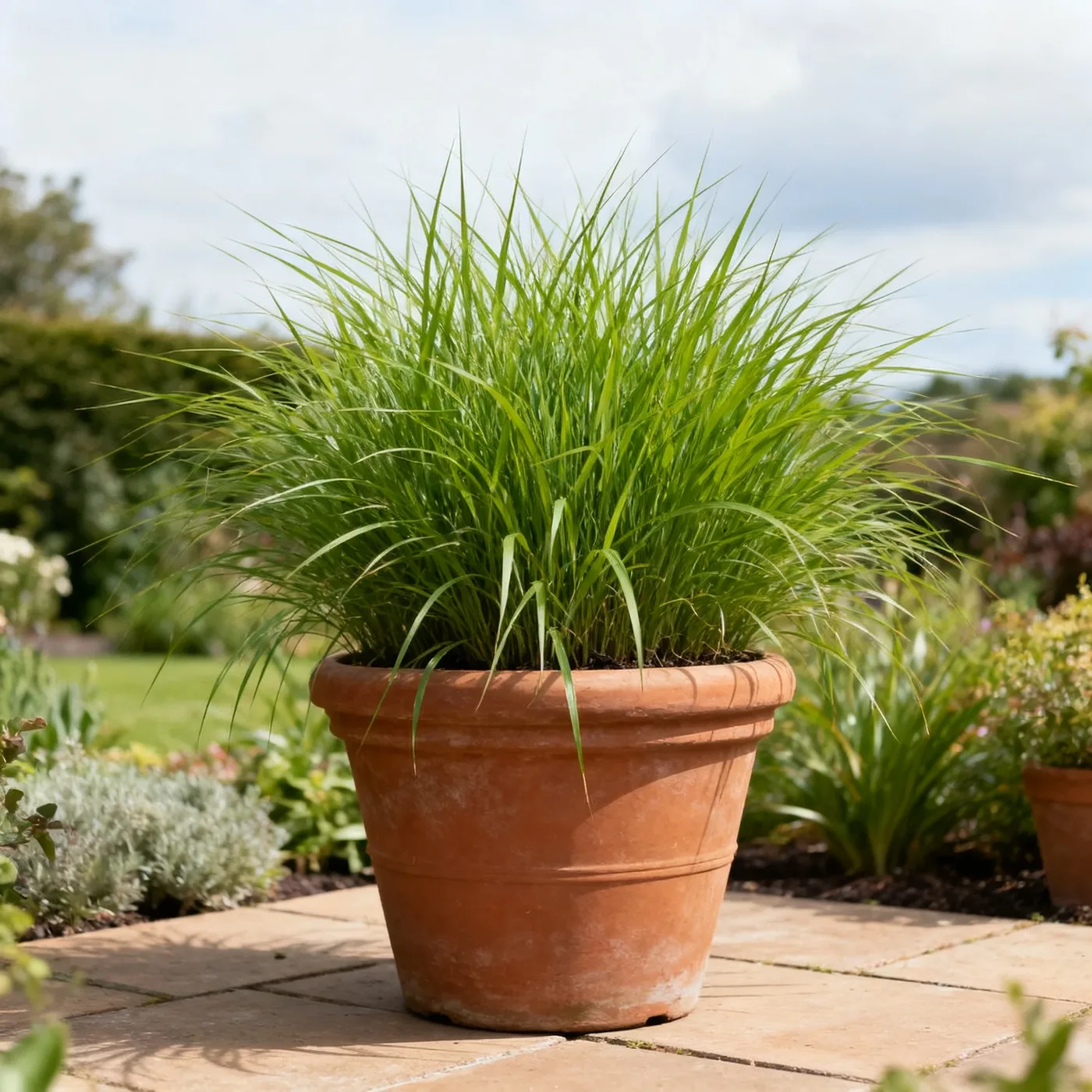
Height is where this plant parts ways with its relatives. Little Kitten reaches 3–4 feet with its silvery-white plumes, which open in mid to late autumn. Against a 6-foot fence, that is roughly the lower half to two thirds of the boards. The fence stays visible. This row is an edge, not a screen.
For context, the species itself runs 4 to 12 feet tall, so this cultivar sits at or below the bottom of that range. Do not borrow species numbers when you plan. In summer you will see only the arching foliage, and the plumes add their height once autumn arrives.
Site and Care Along the Row
For site, give it full sun, which is how K-State's ornamental grass trials list it, and it is listed for zone 5 at the cold end. Past the first season this row asks very little of you. Plant it, water it through its first summer, and leave it alone.
Our guide on how big Little Kitten gets goes deeper on the size itself.
Giant Miscanthus Planted at the Same Spacing
Now run the same fence with Miscanthus x giganteus. Thirteen plants at 3 feet apart gives you the same count on paper, though this grass is planted from rhizomes, which are pieces of root, rather than from a finished potted clump.
The height changes everything. Penn State's extension profile says the plant reaches heights of up to 12 feet. That is twice the height of our 6-foot fence and three to four times the height of Little Kitten. Instead of a band along the bottom of the fence, you would see no fence at all, only a wall of stems.
Bulk Is the Hidden Cost
A plant that tall carries a great deal of leaf and stem, and neighboring clumps will merge into a solid mass. We have no sourced spacing figure for the giant, and we will not guess one. If you are seriously considering it, ask your local extension service what spacing suits your site. Treat 3 feet only as the number we used to keep the comparison fair.
Think about the other side of the fence, too. A 12-foot mass will cast shade and block views for a neighbor, and it needs room to grow without crowding walls, wires or a roofline. None of that applies to a 3–4 foot edge.
Where the Giant Earns Its Place
The upside is real. Because it is a sterile hybrid, there is no concern about invasiveness from seed. If you have a barn, a field edge or a property line to hide, the giant does that job. It is just a job on a different scale from a garden border.
Same fence, same spacing, and the result goes from a low band to a 12-foot wall.
Pricing Forty Feet of Little Kitten Maiden Grass
We leave dollar figures out of guides because they change, but the structure of the cost is easy to see. This table sets the two plants side by side along the same 40 feet.
| Along 40 feet | Little Kitten | Giant miscanthus |
|---|---|---|
| Plants at 3-foot spacing | 13 | 13 (confirm giant spacing locally) |
| How it is planted | Potted clumps | Rhizomes |
| Height at maturity | 3–4 feet | Up to 12 feet |
| Share of a 6-foot fence covered | Half to two thirds | All of it, twice over |
| Total cost | 13 times the price of one pot | Count times the price per rhizome |
For Little Kitten, the math is simple: 13 pots, one per spot. Look up the current price of a single plant, multiply by 13 and you have your budget. A potted clump also shows you what you are getting, because you can see the foliage before it goes in the ground. Our buying guide for pots and sizes explains what to look for when choosing a pot.
The giant works the same way, rhizome price times count. Do not stop at purchase price, though. A 12-foot stand takes more room, more effort to cut and more thought about where it ends. A row that stays at 3–4 feet costs you the pots and nothing more.
There is also the cost of a wrong guess. Replacing 13 oversized plants is a lot more work than replacing 13 small ones, which is one more reason to settle the size question before you order.
Why the Biofuel Hybrid Is a Different Plant Entirely
We often see shoppers assume the giant is simply Little Kitten grown large. It is not, and a surname makes the point. Two people can share one, and that tells you they come from the same family, not that they are the same height or do the same work.
Bred for Biomass, Not Borders
Giant miscanthus is a sterile hybrid grown as a crop. Penn State describes it being pressed into fuel pellets or biomass logs for combustion and used as a feedstock for cellulosic biofuel. Its sterility and rhizome planting suit a field crop. Nobody selected it to look good beside a patio.
Where Little Kitten Comes From
Little Kitten is a cultivar of Miscanthus sinensis, a species native to Asia, with a home range that includes Japan and China. It was chosen for its compact habit, silvery-white plumes and golden fall foliage. So when a search result mentions a 12-foot miscanthus, you are looking at a different plant. Check the botanical name on any label: 'Little Kitten' is the one you want here.
One Honest Caution About Seed
Sterility is the one place the giant has an edge. The species Little Kitten belongs to is considered invasive in parts of the U.S., according to University of Wisconsin extension. We cannot promise how any single cultivar behaves in your region, so ask your local extension service before planting near open land.
For similar small plants, see other dwarf miscanthus that suit tight spaces.
Redrawing the Plan With Little Kitten Maiden Grass
Now fix the fence plan so each plant lands where its size fits. Say 15 feet of the fence runs along a patio, where you want something low and soft that does not block the view. The other 25 feet faces a neighbor's driveway, and you would like to hide it. Different jobs, different plants.
- Measure each stretch. Write down the length and how tall the finished plants need to be. Our two stretches are 15 feet and 25 feet.
- Give anything under about 4 feet to Little Kitten. The patio stretch takes 5 plants, since four 3-foot gaps plus one clump width cover 15 feet.
- Reserve the giant for true screening. The 25-foot stretch is its job, but only if you can accept up to 12 feet of height. Confirm spacing locally before you count rhizomes.
- Check the sun. Both do best in full sun, so a shaded corner needs a different plan.
Our own choice, and we think it fits most yards, is Little Kitten along the whole 40 feet, with a tall shrub or a fence panel behind it for the privacy part. A 12-foot grass is rarely what a home garden needs. It earns its place on larger properties with room to spare.
That choice also keeps upkeep light. A compact clump is cut back once a year in late winter, and our guide to planting Little Kitten covers the steps for getting all 13 in the ground. The landscape ideas page shows what to pair with that patio edge.
Little Kitten Maiden Grass for Edges, Giant for Walls
Little Kitten suits low edging, at 3–4 feet tall and about 3 feet wide, with silvery plumes in mid to late autumn and golden fall color. Giant miscanthus suits tall screens where you have the room, with stems that can top out at 12 feet. They are different tools for different jobs. Measure the space first, then pick the plant whose mature size fits that measurement.
Little Kitten Maiden Grass
Nursery-grown Little Kitten Maiden Grass in sizes from 3 Gallon, shipped to your door.
From $69.97
Shop Now →Rows of Little Kitten grow in full sun across our farms, and we pot and pack each one by hand. Raising and selling top-quality grasses from land of our own is what our small business is all about. Once you have measured your edge and know a 3 to 4 foot grass fits, we hope you will take a look.