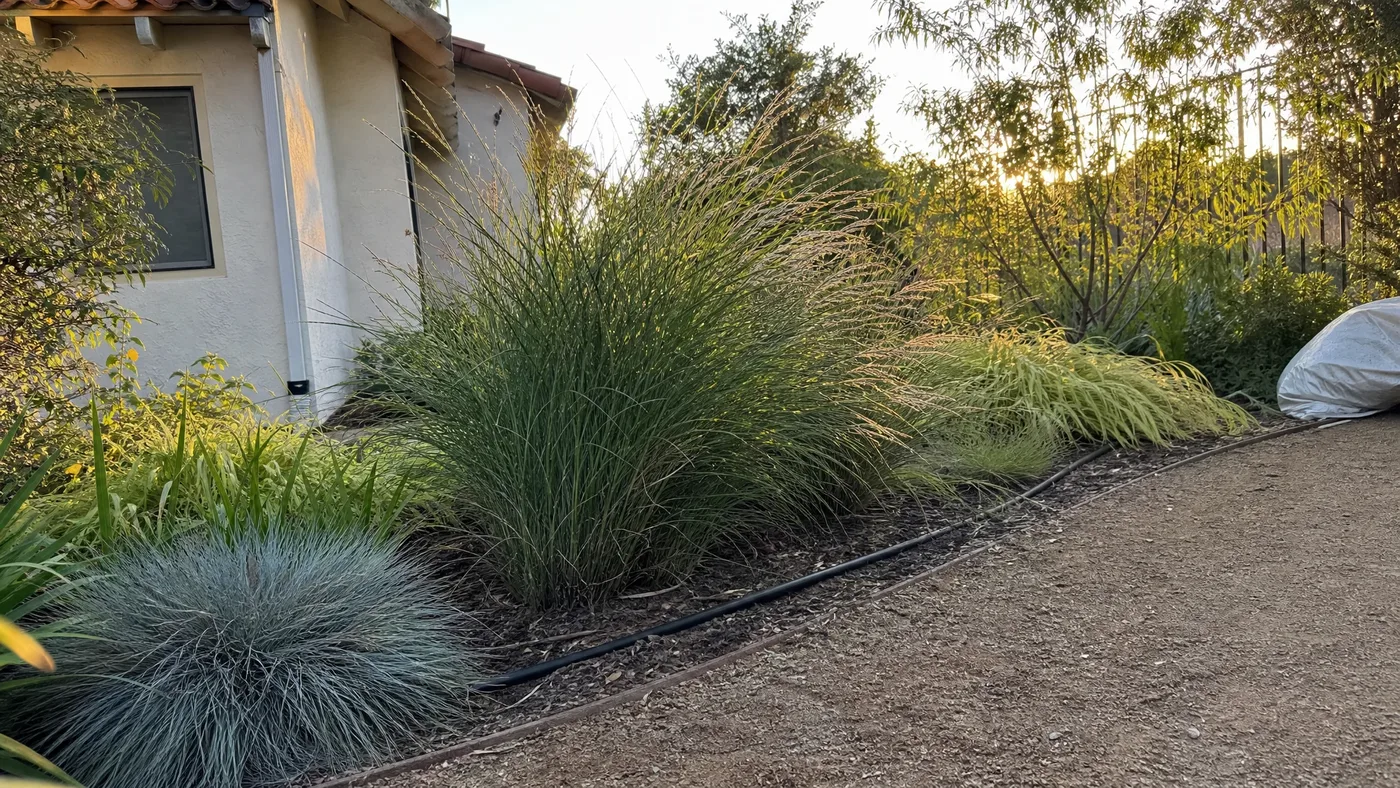
Little Kitten Maiden Grass vs Other Small Ornamental Grasses
Picture yourself standing over a small gap in the ground with a handful of plant tags in your fist: Little Kitten, blue fescue, a sedge, maybe a Hakonechloa. The tags all say "small grass," but the soil is the thing deciding, and it will let each of these plants do very different things.
We often see shoppers choose by height alone. A grass that suits dry, sunny ground sulks in damp shade, and the reverse is just as true. Get the match right and Little Kitten gives you silvery-white plumes that carry the bed into winter with almost no work.
Below, you'll find out all about how Little Kitten Maiden Grass compares with blue fescue, sedge and Hakonechloa, including a dry side bed, a windy corner, a hot deck pot and a damp clay patch under a maple.
Little Kitten Maiden Grass in a Narrow Side Bed
Side beds along a house are usually dry for a reason. The roof eave throws rain past them, and the foundation drinks what is left. Fast drainage, meaning water leaves the root zone quickly, suits a Miscanthus, and maiden grass is extremely drought tolerant once it is established. In a sunny strip, Little Kitten will send up its plumes each autumn without a hose.
Sun is the other half of the question. Little Kitten wants full sun to part shade, and as a rule the more direct light it gets, the better it does. A strip that sees sun for most of the day suits it. A north-facing one does not.
Width Is the Catch
Here is where we push back on a habit: people hear "dwarf" and assume "narrow." Little Kitten reaches about 3 to 4 feet tall and 3 feet wide, which is small only next to a species that runs 4 to 12 feet. In a strip under 3 feet wide, the arching leaves will lean over the path or the wall as the clump fills out.
One of the most common questions we get is whether it will fit a 2-foot strip by the foundation. It will not stay tidy there. Give it its full 3 feet, and if you want other Miscanthus options first, our guide to other dwarf Miscanthus cultivars compares them.
Getting It Established in Dry Ground
Dry does not mean no water at the start. Established means the roots have spread beyond the original planting hole, and a new clump has not done that yet. Water it regularly through the first growing season, then ease off and let the drought tolerance do its job.
Where Fescue and Sedge Win
For a truly slim bed, blue fescue is the better pick. The clumps grow 10 to 12 inches high with a similar spread, expanding outward only slowly. It also wants full sun and well-drained soil. Its weakness is winter: it stays evergreen only in mild climates and may turn brown in harsher ones.
If the strip is shaded, skip both and look at sedge. Pennsylvania sedge ideally wants dry to moist shade and does not want full sun. Oshima sedge stands 1 to 1.5 feet tall and is hardy in zones 5 to 9. Neither gives you plumes, but both fill a shady slot that Little Kitten would resent.
Our rule: 3 feet of sun, Little Kitten. Less width, fescue. Less sun, sedge.
A Windy Corner Lot and the Winter Plumes
Wind changes the question from "what looks good in July" to "what is still standing in January." Little Kitten blooms in mid to late autumn, and its silvery-white plumes last a long time. Colorado State Extension notes that Miscanthus are known for silky flower tassels that persist into winter, and on an exposed corner that standing structure is the reason to choose this grass.
The species is different on color. Plain Miscanthus sinensis carries pinkish plumes and flowers anywhere from August to November, while the cultivar stays silvery-white and opens later. That later, cleaner show suits a corner you see mostly in the cooler months.
Compare the alternatives on the same corner. Hakonechloa dies back to the ground in winter, so after the first hard frost there is nothing left to look at. Pennsylvania sedge is semi-evergreen but dies back under very cold temperatures. Blue fescue browns in harsh winters. Only the Miscanthus gives you height through the cold months.
Why Compact Height Helps in Wind
Wind works like a lever, and a taller clump gives it a longer one. The species runs 4 to 12 feet, while Little Kitten stays around 3 to 4 feet with plumes, so there is less stem to catch the gust. We know of no trial that measured a wind speed it will take, so treat this as sound reasoning, not a guarantee. A short, dense clump is still the better bet on an open corner.
Wind also dries soil and leaves faster than still air does. Even a drought-tolerant grass needs regular water until it is established, and a corner lot is where that first season matters most. After that, a deep soak in a long dry spell is plenty.
Keep feeding light. Heavy nitrogen pushes soft, fast growth, and soft stems are the ones that fall in a gale. Our fertilizing guide explains why lean soil usually gives the sturdiest clump.
Leave It Standing Until Spring
The plumes only earn their place if you leave them up. Cutting back in fall removes the structure you planted for, and a bare stubble on a windy corner looks worse than a bleached clump. Wait until late winter, before new growth shows at the base, and follow our guide to cutting back Little Kitten.
On wind and winter, we would choose Little Kitten over every other plant in this guide.
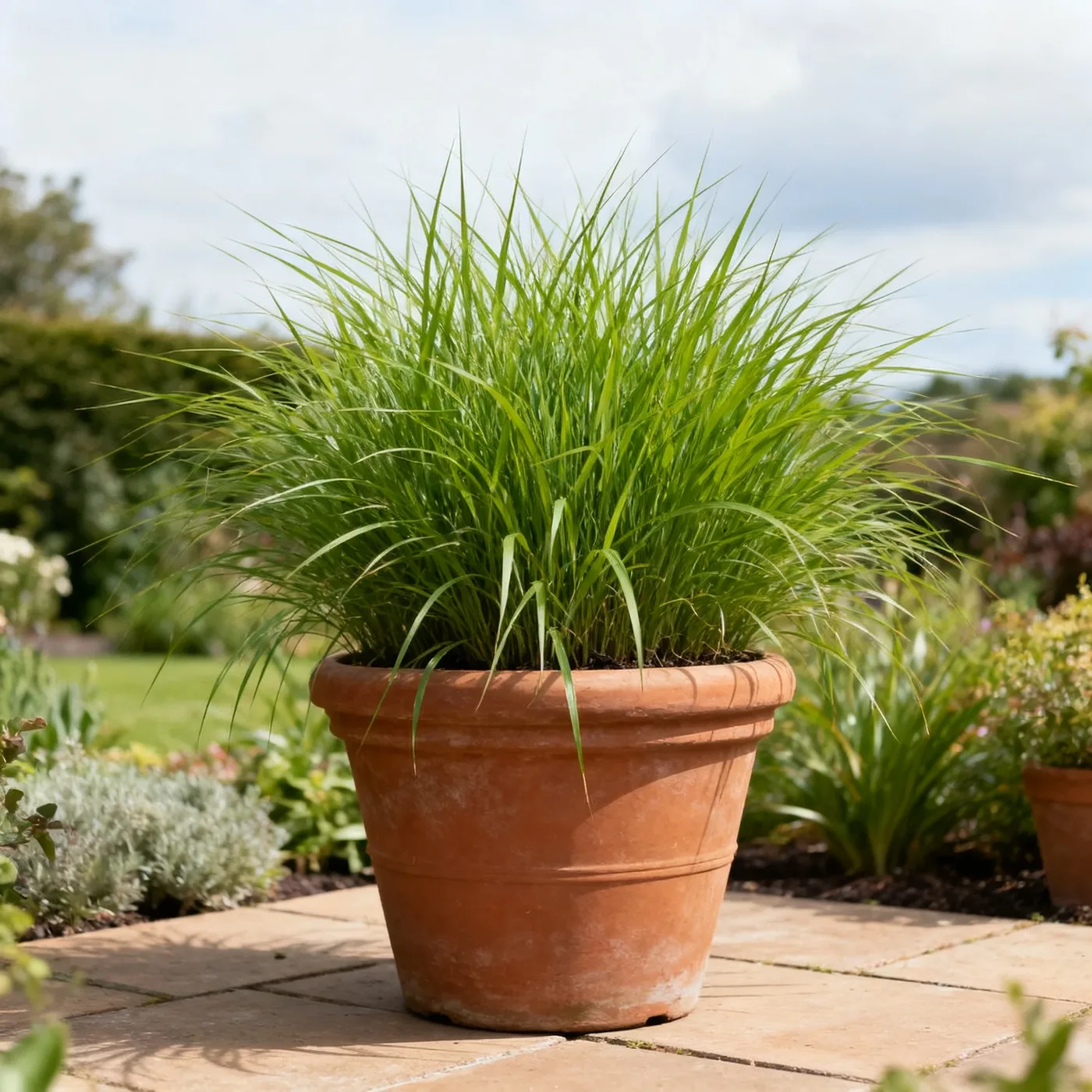
A Hot Deck Pot Where Roots Bake
A pot on a sun-baked deck is a different problem from a bed. Ground soil buffers temperature, but a pot's sides take the sun and the deck radiates heat from below, so roots can sit in mix far hotter than the air. Hot roots lose water fast and struggle to take it up again. Every plant in this guide feels that, though not equally.
Little Kitten starts with an edge because it likes full sun and is drought tolerant once established. The catch is that word, established. In a pot the roots cannot reach for deeper moisture, so the drought tolerance described for ground-planted grass does not carry over fully. Treat the plant as a regular-watering plant until it has filled its container.
Setting Up the Pot
Our guide to growing Little Kitten in pots and containers covers the full setup. What we tell customers about heat comes down to a few points:
- Choose a light-colored or thick-walled pot, because thin dark plastic heats fastest and cooks the roots on its sunny side.
- Pick a container generous enough for a clump that reaches about 3 feet across in the ground, since a cramped pot dries out and heats up quickly.
- Use a gritty, fast-draining mix, because water in a pot can only leave through the holes and a soggy base in summer heat invites root trouble.
- Mulch the surface, and set a lower plant in front of the sun-facing wall of the pot to shade it.
- Raise the pot on feet so deck heat does not conduct straight in and air can move underneath.
How the Others Handle the Pot
Blue fescue is the natural rival here. It is small, takes full sun and wants well-drained soil, all of which suit a deck pot, and its 10 to 12 inch clump fits a modest container. Its weak spot is the same as in the ground: it may brown in harsher winters, and roots in a pot get less protection from cold than roots in a bed.
Hakonechloa and sedge are shade plants, so on a hot deck they belong on a north-facing patio, not a south-facing one. Put either in a baking pot and you are asking for scorched leaves. If your deck gets afternoon sun, that decides it for you.
Winter is the other risk. Little Kitten is listed for zone 5, but a pot has far less insulation than the ground, so a cold-zone container is a bigger gamble than a cold-zone bed. Ask your local extension service how pots overwinter in your area.
Our pick for a hot deck in full sun is Little Kitten, with blue fescue as the smaller option.
Heavy Clay Under a Maple: Where Little Kitten Maiden Grass Loses
This is a site where we would not plant Little Kitten, and we say so as growers of it. Under a maple, two problems stack. The canopy shades the ground, and maple roots fill the upper soil and compete hard for water. Meanwhile the clay below holds moisture through wet spells, so the spot swings between dry on top and soggy beneath.
What Clay Does to Roots
Clay is made of very fine particles with tiny pore spaces between them. Those pores hold water tightly and drain slowly, so after rain the root zone can stay saturated, and saturated soil has little air in it. Roots need oxygen, and without it they decline. That is the cause behind most "my grass died in clay" stories, more than the clay itself.
Extension writing on a related Miscanthus cultivar says it performs well in heavy clay soils and sandy beds, as long as drainage is adequate. That condition does a lot of work. Under a maple we cannot promise adequate drainage, and we would rather tell you now than have you find out in July.
Do not try to fix it by digging a rich pocket of compost into the planting hole. In clay, that pocket can turn into a bowl that collects water around the roots. If you plant in clay at all, plant in a sunny spot and improve the whole bed, not one hole.
Shade Is the Second Strike
Light settles it. Little Kitten is listed for full sun to part shade, and the dense shade under a mature maple is past that limit. We cannot give you a number of hours, but expect a looser clump and fewer plumes as the light drops. Pair that with slow drainage and the grass has two problems it cannot solve.
What to Plant Instead
Hakonechloa is the usual answer. It stands 1 to 1.5 feet tall and 1 to 2 feet wide, tolerates part to full shade and colors best when shielded from full sun. Its price is winter, because it dies back to the ground and leaves the bed bare from frost until spring.
Pennsylvania sedge is the tougher choice for the worst of the site. It tolerates heavy shade and wet soils, though its ideal spot is dry to moist shade, and it stays semi-evergreen. At 1 to 8 inches tall, it works as a ground cover, not an accent.
If you love the plumes anyway, plant the grass in a sunny, well-drained spot elsewhere and put the sedge under the maple.
Choosing Little Kitten Maiden Grass Only When the Soil Agrees
Across all four yards the pattern is the same: the plant is not the variable, the soil and light are. Miscanthus does best on moist but well-drained soil in open, sunny places, and the wild species grows on light, well-drained ground low in nutrients. Those are the conditions to copy. The table below matches each site we walked through to the plant we would put there.
| Site | Soil and light | Our choice |
|---|---|---|
| Dry strip, 3 feet wide or more | Fast drainage, full sun | Little Kitten |
| Dry strip, under 3 feet wide | Fast drainage, full sun | Blue fescue |
| Windy open corner | Exposed, well drained | Little Kitten |
| Hot deck pot in full sun | Gritty mix, full sun | Little Kitten, or blue fescue for a small pot |
| Shaded bed, dry to moist | Shade | Pennsylvania sedge |
| Damp clay under trees | Slow drainage, shade | Hakonechloa or sedge |
Test the Drainage Before You Shop
If you are unsure what your soil does, find out before you buy. Dig a hole, fill it with water, let it drain, then fill it again and watch. If water is still standing well after the second fill, drainage is slow and the grass will struggle. Our guide to soil, pH and drainage for Little Kitten goes further.
On pH, seed of the species has germinated across a wide range, from 4.3 to 8.5, but we have no pH range for the cultivar itself. Drainage and sun matter far more than a pH number here, and your county extension office can test your soil cheaply.
Matching Little Kitten to the Ground You Have
Little Kitten wins where the ground is sunny, open and drains fast: a side bed at least 3 feet wide, a windy corner or a pot kept cool at the roots. Blue fescue takes the tighter strips, and sedge or Hakonechloa take the shade. The grass loses in damp clay under a maple, and we would rather you pick the right plant than the right label.
The plumes, the golden fall foliage and the winter structure are all there for the taking, but only if the roots are happy first. Match the grass to the soil's drainage and the plant will do the rest.
Little Kitten Maiden Grass
Nursery-grown Little Kitten Maiden Grass in sizes from 3 Gallon, shipped to your door.
From $69.97
Shop Now →Full sun and ground that sheds water quickly are what Little Kitten gets in our rows, and that is the same spot we hope you will give it when you set it beside the other small grasses in this comparison. Our crew grows plants on farms of our own, and every top-quality grass we send out is one we would put in our own borders. If you have settled on Little Kitten for your garden, we would be glad for you to pick out a plant.