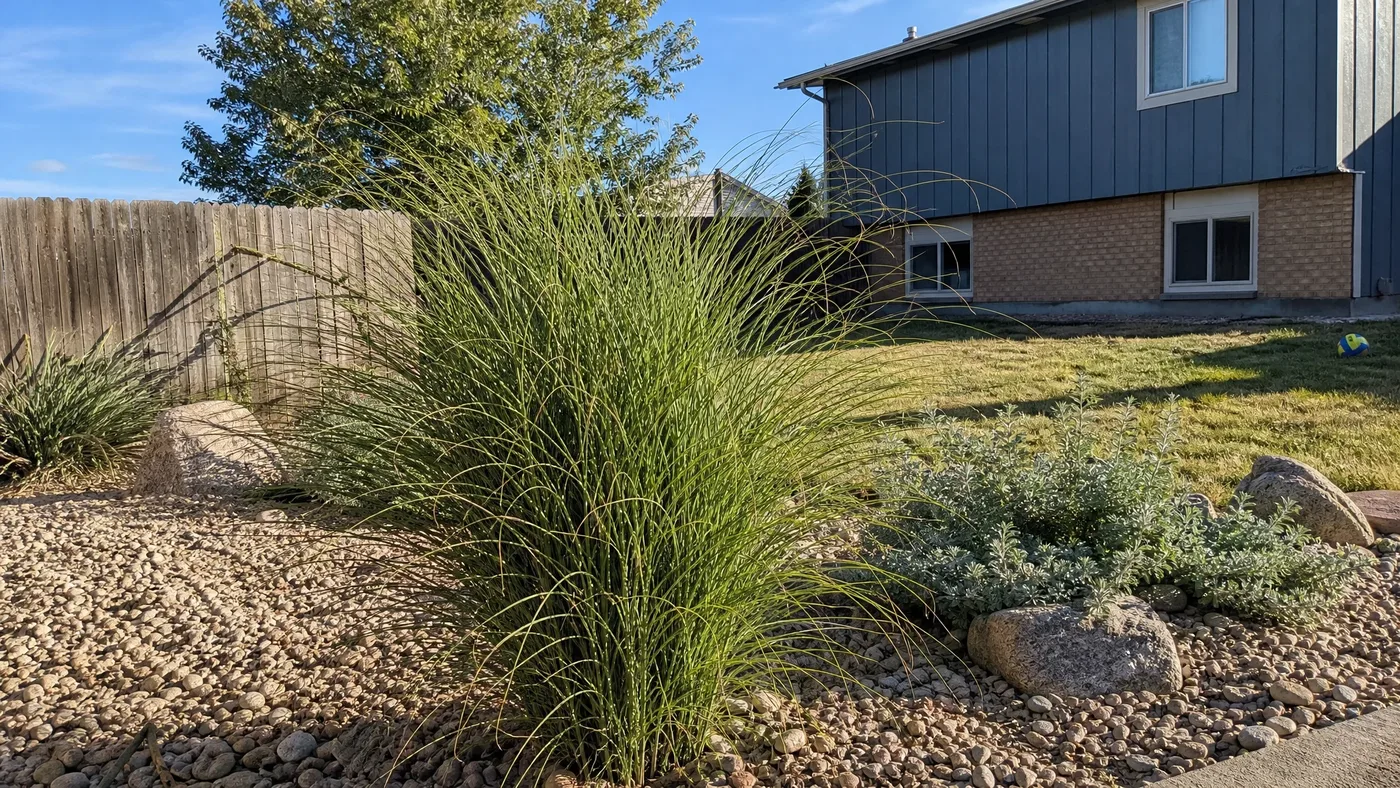
Little Kitten Maiden Grass Foliage: Color, Texture and Habit
Stand at the back of your yard around dusk and look across the whole of it. Before you notice a single flower, your eye lands on the low, fine-textured mound still catching the last light. That is what Little Kitten does in a garden, and it does it quietly.
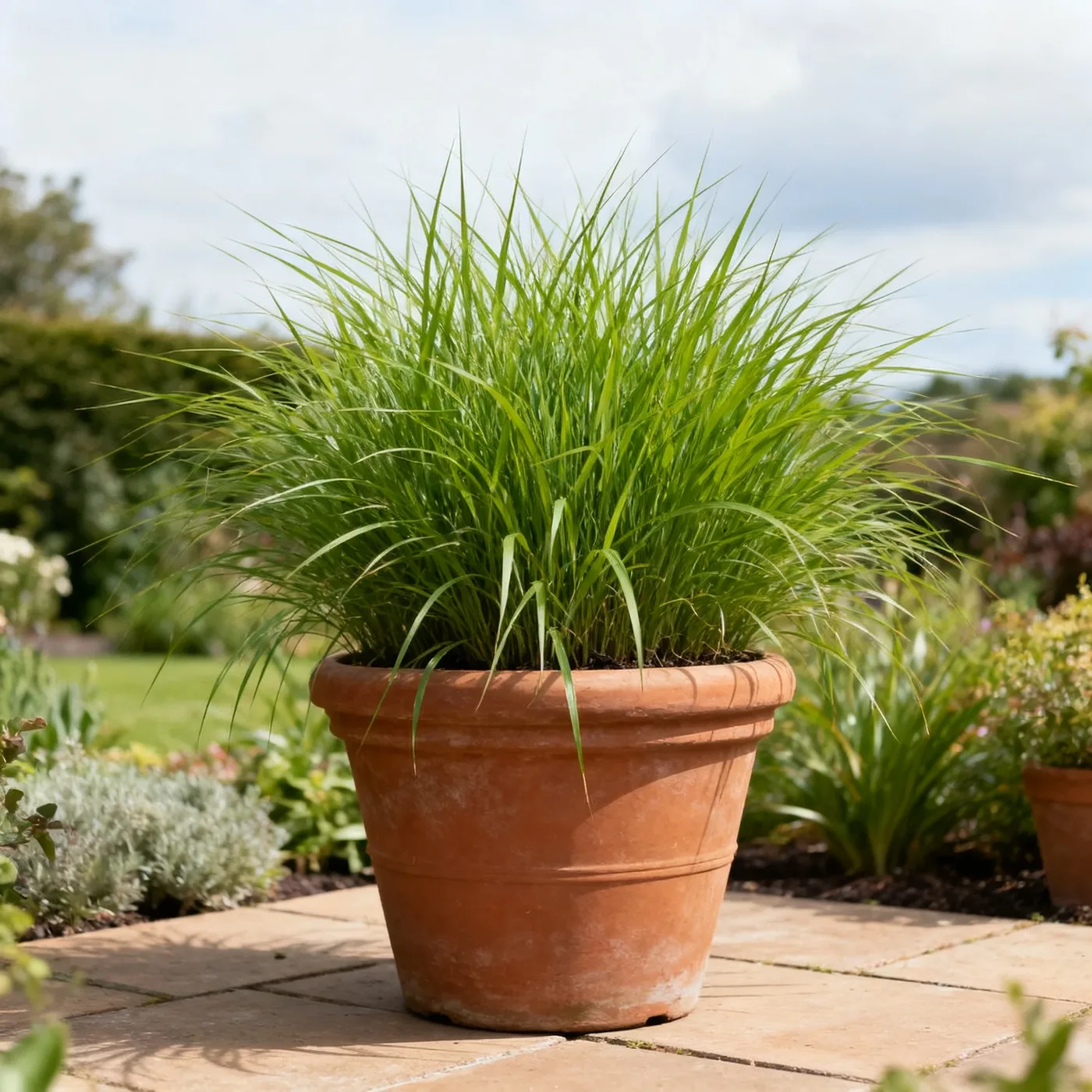
This article talks about how Little Kitten Maiden Grass looks at every distance, from the whole landscape down to one blade, and answers the questions customers ask us most. Read on to learn how the mound sits beside other plants, how the clump holds its shape, how the foliage moves from green to gold, and how narrow the blades really are. A pot spec says 3–4 feet tall and about 3 feet wide. It does not say what you will actually see.
How Little Kitten Maiden Grass Reads in the Whole Landscape
Step back far enough and plants stop being individuals. Shapes, textures and masses of tone take over, and in that wide view Little Kitten behaves like a soft, pale punctuation mark. It does not shout from across the lawn. It settles into the scene and makes everything near it look a little calmer, which is a bigger job than it sounds.
The Role It Plays in a Full Scene
From the patio, Little Kitten does not read as a plant with parts. It reads as one rounded form made of fine lines, and that is why designers lean on it. It reaches about 3–4 feet tall with plumes and about 3 feet wide, while the species it came from runs 4 to 12 feet tall. You get the full grass effect without a wall of foliage across the view.
In a large scene it works as a repeating note. Set three or five along a walk, a bed edge or a driveway curve, and the eye connects them the way it connects fence posts, only softer. A single clump in open lawn can look small and a little lost, so we plant it in groups and let the mounds echo each other. Because it stays low, it frames what is behind it instead of hiding it.
One of the most common questions we get is whether a dwarf grass disappears in a big yard. It does not if you repeat it. Scale comes from the rhythm, and our size guide shows what each clump will do on its own.
What Happens as the Light Drops
This is the moment the plant earns its place. Fine blades catch low, slanting sun along their edges in a way broad leaves cannot, so at dusk the mound seems to hold light a few minutes longer than the plants around it. Put the sun behind the clump and the whole form glows from within. In mid to late autumn the silvery-white plumes join in, standing just above the blades like fine smoke.
Open-sky sites show this best. Plant the grass where you actually look at the yard from, such as the kitchen window, the porch step or the end of the lawn, and give it a dark background like evergreen or a fence. Pale blades against deep green read far more strongly than against a pale wall. Since Miscanthus tassels persist into winter, the scene does not end at the first frost.
The Mound Against Its Neighbors
Texture is the whole argument for this grass beside other plants. Little Kitten has narrow blades, roughly half the width of standard Miscanthus, and those fine lines look best next to something broad, glossy or bold. Put it beside another fine-textured plant and both disappear into a haze. The table shows how we think about the common pairings.
| Neighbor | What you get | Where we place the grass |
|---|---|---|
| Broad, bold leaves | The strongest contrast, fine lines against large surfaces | In front, so blades overlap the leaf edges |
| Stiff, upright perennials | A soft arch against a rigid vertical | At the base of the stems |
| Rounded evergreen shrubs | A pale, airy mound against dark mass | In front of the shrub, so the shrub acts as a backdrop |
| Other fine-textured plants | A blur with little contrast | Separate them with one bolder plant |
Scale Against Taller and Lower Plants
At 3–4 feet with plumes, Little Kitten sits at mid-height, which makes it a bridge between low edging plants and taller background plants. Common advice puts every grass at the back of the border. We do the opposite with this one, because its fine blades and low mound are worth seeing up close, and at the back they just look like a smaller version of a bigger grass.
Keep a size gap between it and its taller neighbors. A plant twice its height gives a clear step, while one of nearly the same height competes with it for the eye. Our landscape ideas guide walks through full combinations if you want to plan a whole bed.
Reading the Mound From the Side
Beds are usually seen at an angle, from a path or a window, so think about the silhouette as well as the top view. The mound makes a gentle, rounded edge that softens the hard line where a bed meets a walk or a wall. Place it a little back from stone or concrete edges so the arching tips can fall over the edge without being pinned against it.
Little Kitten Maiden Grass Clump Shape Up Close
Walk up to one plant and the shape resolves into a fountain. The blades rise from a tight crown, lean outward, and curve down at the tips so the mound reads as rounder than it is tall. Plant to plant, that is a habit of the species, and the Illinois extension describes it as a thin blade that tends to arch to the ground. Little Kitten simply does it at a smaller footprint.
How the Blades Arch
Little Kitten spreads about 3 feet across where the species can reach 4 to 6 feet. The result is dense and evenly filled, with few gaps showing the crown. The density comes from the narrow blades. More of them fit in the same space, so the clump looks full from the base and has no bare shoulder.
It is also a true clumper. It widens slowly from the center instead of running along the ground, so the edge of the mound stays where you planted it. If you set plants 3 feet apart, expect the mounds to meet gently rather than fight.
Why the Clump Stays Round
A round mound depends mostly on light. Little Kitten takes full sun to part shade, but full sun gives the tightest, most upright fountain, while deep shade lets the blades open and lean. Place it where it gets plenty of sun and the shape takes care of itself. Our sun requirements guide covers the trade-offs.
The plumes add a second layer. They are silvery-white, appear mid to late autumn, and rise above the blades to lift the outline. Our bloom time and plume color guide covers when to expect them. Leave the whole clump standing through winter and the mound keeps its rounded outline instead of turning into a bare stump.
Foliage Color From Green to Gold
The species varies a lot in color. Foliage coloration ranges from green to silver blue to white and yellow variegation, and plenty of its dwarf cultivars take advantage of that. Little Kitten does not. Its foliage is plain solid green, with no banding like Little Zebra and no white midrib like Little Miss. That plainness is a strength, because it lets the plant sit calmly beside colorful companions. Our guide to other dwarf Miscanthus compares the siblings side by side.
What it does have is a color story across the year, summarized here.
| Stage | What you see |
|---|---|
| Spring and summer | Even, solid green, with no stripe or band |
| Early autumn | Green warming toward yellow as the days shorten |
| Mid to late autumn | Golden foliage with silvery-white plumes |
| Winter | Faded blades with the long-lasting plumes still standing |
How Light Changes What You See
Color depends on the angle of the sun as much as on the season. At midday in summer, the green reads as a steady medium tone. At dusk, backlit blades turn nearly luminous, and in autumn the gold deepens as the light lowers. The same plant looks like three different plants in one afternoon.
The gold is gentle, so it suits quiet palettes. Our fall color guide goes into the timing in more detail.
Pairing Green and Gold With Other Colors
Solid green is the easiest color to design around. In summer it acts as a neutral that lets bright flowers stand out, and the fine texture keeps the bed from looking busy. In autumn the gold picks up warm tones in nearby foliage and berries, and it holds its own beside deep burgundy or purple leaves. We tend to avoid planting it beside other yellow-toned grasses, since the two cancel each other out.
Blade Width and the Feel of a Single Leaf
Closer still, the plant is only blades. Hold one up against the sky and you can see why the mound behaves as it does: a long, slim strap, finely pointed, that bends easily and catches light along both edges. Everything we have described so far, from the glow to the density, starts with this one narrow shape.
How Narrow Is Narrow?
The species has leaf blades usually 8 to 12 millimeters wide, which is about 1/3 to 1/2 inch, and the species range runs from a quarter inch to as much as 2 inches. Little Kitten sits at roughly half the width of a standard Miscanthus blade. Pinch one between your fingers and it feels more like a ribbon of thin grass than a flat leaf. That narrowness is the reason for the dense clump, the fine texture and the glow at dusk.
Finish and Movement
Because every blade is solid green and slim, the clump reads as many tiny identical lines rather than a few broad shapes. Move your hand through it and the blades flutter. In a light breeze the whole mound shimmers, and the fine tips shift before the rest of the plant does. We often see customers stop in our rows to run a hand over it, and the first thing they say is how soft it is.
Broad-bladed grasses rustle. Little Kitten whispers. If you want a plant that adds motion without noise or bulk, this is the one.
What to Check on a Young Plant
We grow Little Kitten in full sun on our own farms, so the plants we send out should already show the habit described here. Use this short list whenever you size up a plant, whether it is ours or not.
- Blades should be slim and uniformly green, without any stripe, band or pale midrib.
- The crown should look full, with blades rising evenly from the center.
- The tips should arch outward into a rounded fountain, even on a small plant.
- Any early fall tint toward gold is normal and not a sign of trouble.
What Little Kitten Maiden Grass Looks Like Once You Know It
Carry this picture home. Little Kitten is a low, rounded mound about 3 feet across, made of fine solid-green blades that arch like a fountain, turn gold in autumn, and carry silvery-white plumes above them. It contrasts with bold neighbors, skips the variegation of its siblings, and gives a garden a soft, repeatable note from patio to path.
Then picture dusk again: the whole yard going dim, and one narrow blade at the edge of the mound still glowing in the low light, a single bright line that ties the tiniest detail back to the whole garden.
Little Kitten Maiden Grass
Nursery-grown Little Kitten Maiden Grass in sizes from 3 Gallon, shipped to your door.
From $69.97
Shop Now →Little Kitten spends its early life in our open, sunny rows where the soil drains freely, which is how we keep that fine green mound compact and its blades glowing at dusk. Our own farms raise every grass we sell, since we are a small business that tends its stock from start to finish. Have a look at what is in stock now and bring home the mound you just pictured.